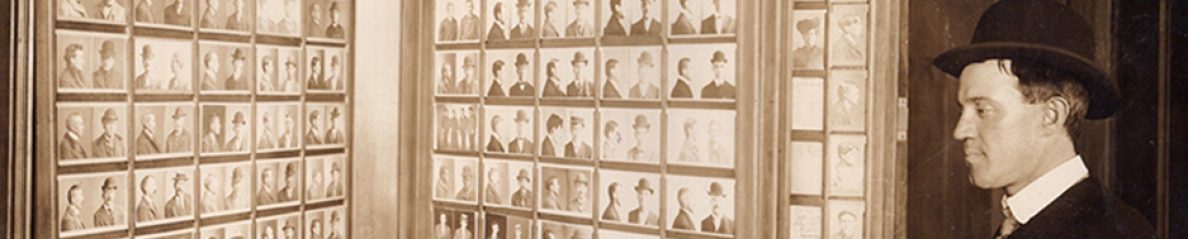

One of America’s most notorious nineteenth century murder defendants apparently escaped a routine indignity of criminal identification: the police mugshot. Was it because she was a respectable woman, or simply because police procedures had not yet caught up with the technology?
On August 11, 1892, Lizzie Andrew Borden was arrested in Fall River, Massachusetts, and charged with the brutal murders of her father, Andrew Jackson Borden, and her stepmother, Abby. The murders had occurred one week earlier, on August 4, in the family’s home at 92 Second Street. Both victims had been attacked with a hatchet.[1]
The case became a national sensation. Newspapers published portraits of Lizzie, illustrations of the murder scene, and detailed accounts of her appearance and behavior. Yet, curiously, there is no known police mugshot of the woman who would become one of the most famous murder defendants in American history.
Why not?
Mugshots Were Nothing New
By 1892, the use of photography to identify criminals was hardly an innovation. American police departments had been photographing prisoners since the middle of the nineteenth century.
Boston established a collection of criminal photographs in the 1850s, and New York City developed an extensive rogues’ gallery during the following decades. By the 1880s, photographs of thieves, confidence artists, forgers, and other offenders were familiar tools of police identification.[2]
Women were certainly not exempt from the practice. Female pickpockets, shoplifters, and swindlers appeared in police photograph collections, sometimes alongside their male accomplices. Thomas Byrnes, New York City’s celebrated detective inspector, included portraits of 18 female criminals in his 1886 book Professional Criminals of America. These women’s offenses were much less serious than the double murder with which Lizzie Borden was charged.[3]
The technology existed. The precedent existed. And Lizzie Borden was unquestionably in police custody. Nevertheless, no authenticated police identification photograph of her has ever surfaced.
A Lady, Not an Ordinary Prisoner
The circumstances of Lizzie’s arrest and confinement offer a possible explanation. Although Andrew Borden was notoriously frugal, he was a wealthy businessman, and his daughters, Lizzie and her older sister, Emma, belonged to Fall River’s respectable upper-middle-class society. Lizzie was active in church and charitable organizations. She was not the sort of woman local police ordinarily encountered in their dealings with criminals.
Her arrest was handled with conspicuous sensitivity. Contemporary newspaper accounts described officials attempting to shield her from the crowds that gathered to witness her transfer to jail. When she was taken to jail in Taunton, the press emphasized the care with which arrangements were made for her departure.[4]
It is possible that subjecting her to a criminal identification photograph was considered unnecessary, inappropriate, or even humiliating. But there is an important distinction between possibility and proof. No contemporary police record has yet been identified establishing that officials deliberately exempted Lizzie from photography because of her social position.
She Was Hardly an Unknown Criminal
Police rogues’ galleries were originally intended primarily to identify habitual offenders, particularly those who traveled from city to city using false names. Photographs enabled detectives to recognize criminals who had been arrested elsewhere.[5]
Lizzie Borden presented no such identification problem. She had lived in Fall River all her life. Her identity, family connections, residence, and appearance were well known. She was not suspected of operating under an alias or belonging to an itinerant criminal fraternity. There was little danger that she would disappear into another city and resume a criminal career under an assumed name.
In 1892, photographing every person arrested was not yet a universally standardized procedure. The systematic front-and-profile mugshot associated with modern police booking was still developing.[6]
For Fall River officials, obtaining a booking photograph of Lizzie may simply have seemed unnecessary.
The Police Photographed the Dead, but Not the Accused
One of the most striking aspects of the Borden case is that photography played a significant role in the murder investigation itself. Photographs were taken of Andrew and Abby Borden’s bodies on August 4, 1892. These disturbing images survive, providing unusually graphic documentation of a nineteenth-century American murder investigation.[7]
The authorities therefore recognized photography’s value as an investigative and evidentiary tool. They were willing to photograph the murdered victims, but apparently did not create, or at least did not preserve, an equivalent police portrait of the accused. This contrast is intriguing, although crime-scene photography and prisoner identification served different purposes and were not necessarily governed by the same procedures.
What About the Familiar Photographs of Lizzie?
Several portraits of Lizzie Borden circulate today. These images are conventional studio portraits rather than authenticated police identification photographs.
In one familiar portrait, shown above, Lizzie was photographed in a carefully arranged dress, with her face turned slightly away from the camera. The pose and presentation are characteristic of commercial portrait photography.
Did Class Make the Difference?
It is tempting to conclude that Lizzie Borden escaped the camera because she was a wealthy, respectable white woman.
Certainly, nineteenth-century criminal justice was deeply influenced by social class, gender, race, and reputation. The distinction between a respectable woman accused of a crime and a woman already classified as a professional criminal could be considerable. A female pickpocket arrested in New York might have her portrait placed in a rogues’ gallery, while Lizzie, a socially prominent woman accused of murder, could receive markedly different treatment.
Yet class alone cannot explain the absence of Lizzie’s mugshot. Police photography was not universally required, and the surviving record does not establish precisely what identification procedures the Fall River authorities followed in 1892.
Is it possible that a photograph was taken but subsequently lost or destroyed? Without further documentary evidence, we can’t know for certain.
The Photograph That Is Missing
Lizzie Borden was acquitted of murder on June 20, 1893, following a trial that captivated the nation. She returned to Fall River, inherited a substantial fortune, and lived there until her death in 1927.[8]
Her name has endured for more than a century, attached to one of America’s most persistent murder mysteries. Everyone seems to have an opinion on her guilt or innocence, with numerous TV shows and films having been made about the case.
The absence of a police mugshot is a smaller mystery, but a revealing one.
By 1892, photography had become an important instrument of criminal identification. Yet its application remained inconsistent, shaped by local practice, investigative needs, and perhaps the social standing of the accused.
Lizzie Borden’s missing mugshot reminds us that the history of police photography is not simply a history of technological progress. It is also a history of decisions about who deserved to be photographed, who needed to be identified, and who would be remembered as a criminal.
And in Lizzie Borden’s case, the most famous criminal photograph may be the one that was never taken.
Notes
- Library of Congress, “Arrest and Trial of Lizzie Borden,” Chronicling America Research Guides, Introduction. Provides a chronology of the murders, arrest, and trial.
- Wayne A. Logan, “Policing Identity,” Boston University Law Review 92 (2012), 1567 ff., full article. Discusses the early development of American criminal identification practices, including Boston and New York.
- Thomas Byrnes, Professional Criminals of America (New York: Cassell & Company, 1886). Contains portraits and biographical sketches of professional criminals, including women.
- “Taken to Taunton,” The United Opinion (Bradford, Vermont), August 19, 1892, Library of Congress. Contemporary reporting on Lizzie’s transfer to Taunton and the precautions taken by officials.
- Byrnes, Professional Criminals of America, section “Why Thieves Are Photographed.” Explains the identification purposes of police rogues’ galleries.
- “M Is for Mug Shots, the Criminal Identification Portrait,” National Science and Media Museum, article. Discusses the evolution of standardized criminal identification photography.
- The Trial of Lizzie A. Borden, official stenographic report by Frank H. Burt (New Bedford, Massachusetts, 1893), 2 vols., exhibit list; reproduced in “Evidence,” Lizzie Andrew Borden Virtual Museum, transcript and photographs. Documents photographic evidence introduced during the trial.
- Library of Congress, “Arrest and Trial of Lizzie Borden,” Introduction. Confirms the acquittal on June 20, 1893.
A fascinating essay! I’ve been to the Lizzie Bordon Museum in Salem, Massachusetts and bought one of the books about the case, although I can’t remember if the author’s case was for guilt or innocence. I wonder if the case will ever be definitively resolved.
I doubt it! Thanks for reading Liz!