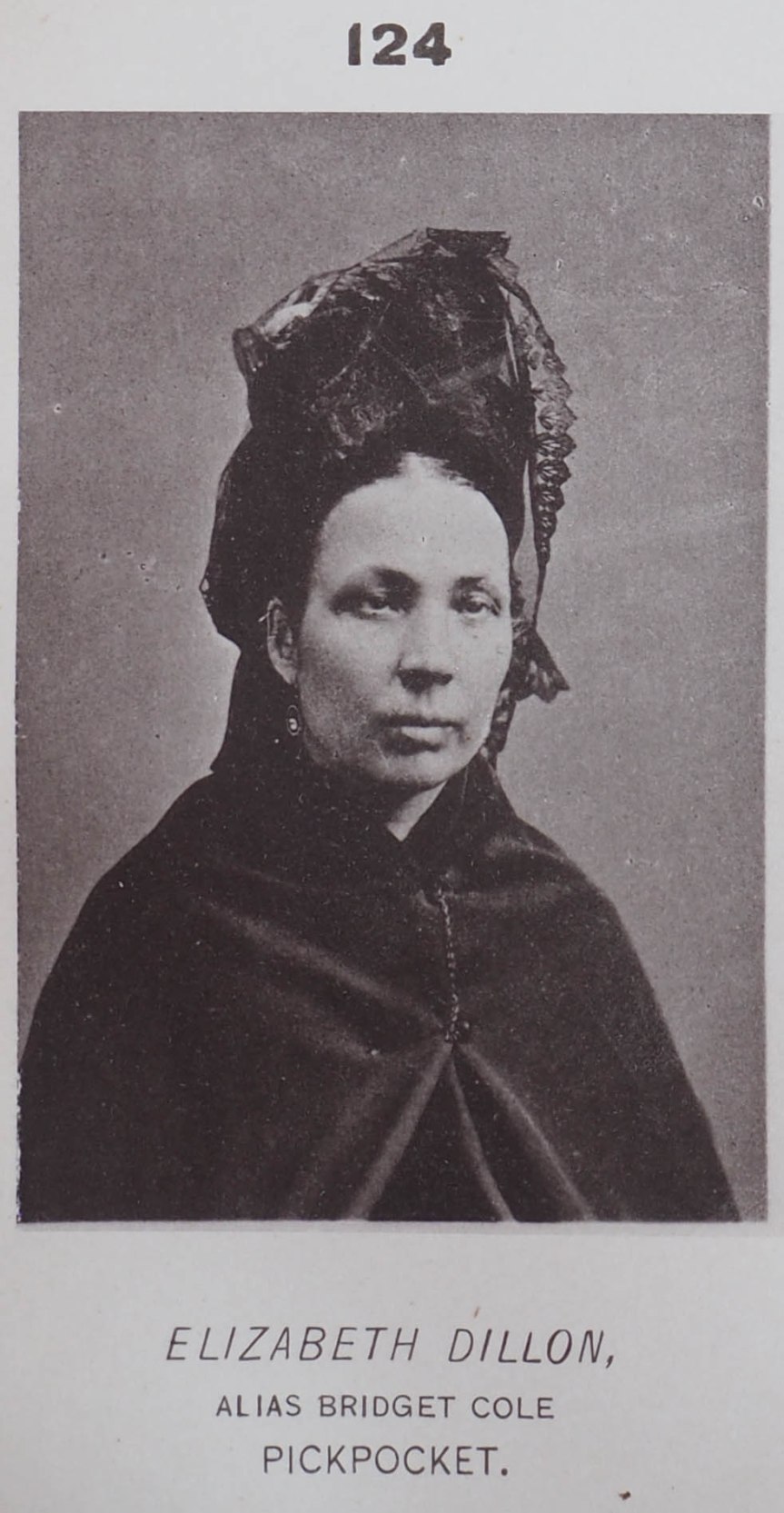
Elizabeth Dillon understood the value of a convincing appearance. In her later years, newspapers described a woman with a motherly smile, gentle manners, and a bonnet tied beneath her chin. She looked like someone a fellow shopper might trust. According to the police, that impression helped her steal.[1]
Shops and crowded transit stations offered opportunities, but Dillon became particularly notorious for picking pockets in churches and at funerals. There, a display of grief could discourage suspicion. One newspaper account attributed this explanation to her: “No one suspects a person who cries well of being a thief.”[2]
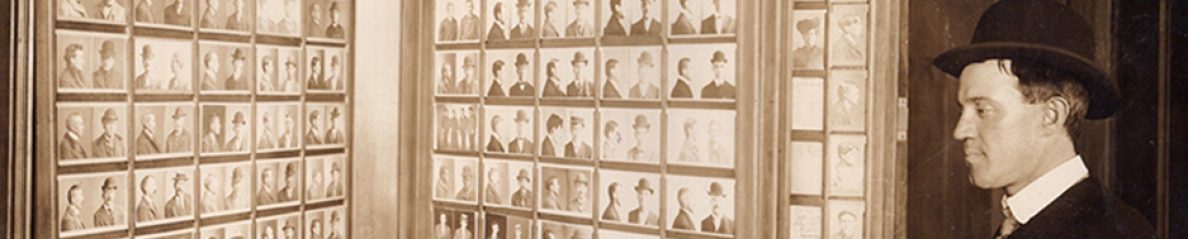
By the time she appeared in Thomas Byrnes’s Professional Criminals of America in 1886, she was already an experienced offender. Her story continued for decades afterward, through repeated arrests, prison sentences, and, eventually, an offer of work that might allow her to support herself legally.
Elizabeth, Bridget, Catherine
Dillon’s history survives under several names. Byrnes identified her as Elizabeth Dillon, alias Bridget Cole. Later newspaper reports called her Liz or Lizzie Dillon, Bridget Corrigan, Bridget Dillon, and Catherine Ryan; Rafferty and Corridon also appear in the accounts.[2][3][4]
Even basic facts about her origins remain uncertain. Byrnes described her as Irish-born and forty-two in 1886, suggesting a birth around 1844. Later newspapers called her English and named Liverpool as her birthplace. Reports also gave conflicting ages. One headline announced that she was eighty, while its text admitted that, like many people in that era, she was unsure of her age herself.[3][5]
These discrepancies make it difficult to give her a reliable birth year or immigration date. They also suggest caution about the repeated newspaper claims that she had spent twenty, twenty-five, or more than thirty years in prison. She plainly served many sentences, but newspapers reports do not establish a dependable total.
Stores, wallets, and an accomplice on the Common
A report published in the Boston Evening Transcript on April 15, 1876, under the heading “Criminal,” describes the arrest of Bridget Cole and Patrick McNelly in Boston. Detectives Drew and Hines watched Cole visit retail stores along Washington and Tremont streets, returning at intervals to McNelly, who waited on the Common. The officers believed that something passed between them before she returned to the shops.[6]
After several trips, the detectives arrested both suspects. They found wallets containing no money; one held railway tickets to Newton, another tintype photographs. Cole and McNelly said they came from Philadelphia. Each was held under $2,000 bail. The clipping reports suspicion and arrest, but does not give the outcome of the case.
Byrnes supplied firmer dates for a subsequent Rhode Island prosecution. Dillon was arrested in Providence on February 1, 1879, and sentenced on March 11 to two years in state prison. Her photograph, later published in his book, was taken that March. He also recorded two subsequent terms at New York’s Blackwell Island penitentiary.[3]
A later newspaper account described the Providence incident as a theft during church prayers. A woman felt a hand in her dress pocket, seized it, and turned to recognize Dillon, a regular churchgoer. Dillon tried to explain the contact as accidental, but was convicted.[2]
“Queen of the Pickpockets”
A brief report published in The Times of Trenton, New Jersey, on May 24, 1895, carried the headline “Queen of the Pickpockets Sentenced.” Its Boston dateline placed the offense in that city: Dillon had been caught stealing among shoppers, found guilty, and sentenced to two years in the House of Correction.[14]
The article named her as Elizabeth Dillon, alias Bridget Rafferty, alias Bridget Cole, directly linking three of the names attached to her record. It gave her age as fifty. Its description of her as “the acknowledged queen of pickpockets and shoplifters” shows that the royal nickname was in print well before the reports of her old age.
A mourner among mourners
Dillon’s methods received extensive attention in August 1901 after an arrest at St. Margaret’s Church on Columbia Road in Boston. She was accused of taking the pocketbook of Ellen M. Doyle, who was attending a friend’s funeral. She gave the name Catherine Ryan, but Chief Inspector Watts and Inspector Barry recognized her as Elizabeth Dillon. Police measured and photographed her again for the rogues’ gallery.[2]
The report, “Mourners a Mark,” portrayed churches as her preferred place to steal. Asked why she chose them, she reportedly explained:
“I go to church for two reasons. One to steal, and the other is because I’m the happiest there. I like to cry, and it is just as easy for me to grieve over the death of a stranger as a friend.”[2]
The newspaper also attributed a boast to her: “My business has been profitable, and it is only by accident that I have ever been caught.”
The same report revisited a Philadelphia conviction in 1887: according to the account, she dropped a pocketbook while trying to conceal it, attracting the victim’s attention. The reported sentence was two and a half years.
Not every arrest led to a conviction. The same article recalled her detention with a man described as her husband at an East Boston church in January 1900. A pocketbook had disappeared, but she was released for lack of evidence.
Later reporting claimed that she and a partner named Dan Corrigan consulted death notices, attended funerals, and sat apart while stealing from mourners. Both, the police said, could produce tears when needed.[1]
Too familiar to go unnoticed
As Dillon grew older, recognition became an occupational problem. Store detectives knew her face. One report said she increasingly avoided the large department stores because so many of their women detectives recognized her.[7]
Her clothing could conceal her hands, but it could also attract attention. In an August 1916 department-store arrest, inspectors noticed her long gray cape. The reporter dwelt on the apparent innocence of her bonnet and matronly manner, presenting the contrast between her appearance and reputation as part of the story.[1]
Her long acquaintance with the police also supplied the newspapers with anecdotes. One report recalled her speaking to veteran Inspector “Joe” Knox: “Why, there seems to be only you and I left; all the other old-timers on both sides of the fence have kicked in.”[1]
A courtroom report published on August 12, 1916, recorded another exchange. Looking toward the women store detectives, Dillon remarked, “O, I know them all.” She pleaded not guilty and appealed to the judge: “Your honor, I never stole this handbag, and it is not true that I tried to steal a woman’s pocketbook. Please let me go. I didn’t do it.” Detective Ethel Lagarstrom testified that she had witnessed both acts, and Judge Parmenter sentenced Dillon to a year in the House of Correction.[8]
“I must eat and have a place to sleep”
Some later prosecutions were for vagabondage rather than a completed theft. On February 4, 1910, the Boston Globe reported that Inspector “Joe” Knox had accused Dillon of working among people rushing to board cars. She pleaded for release and promised to return to New York, but Judge Murray sentenced her to six months for vagabondage.[12] A September 24, 1913, report, “Accused as a Vagabond,” described a law under which a person known as a professional thief could be prosecuted for loitering around a railway terminal or meeting place. In that case, inspectors arrested Dillon at the Scollay Square subway station after watching her mingle with passengers.[9]
Another 1913 report, “Vagrant Sent Away,” described her arrest after surveillance around the Brattle Street subway. Asked why she did not stay away from the subways, Dillon reportedly answered:
“I am an old woman now, and what can I do? I must eat and have a place to sleep.”[7]
Chief Justice Bolster sentenced her to eight months in the House of Correction.
That statement does not explain away the losses suffered by her victims. It does reveal the immediate needs she said she faced, after years in which release from custody was repeatedly followed by another arrest.
A job with a needle
In September 1919, the Standard-Times reported that Dillon had received another one-year sentence from Judge Murray, only months after her release from prison.[13]
In May 1920, Dillon received a different kind of opportunity. Two clippings in the present collection describe the arrangement in detail. One carried the headline “‘Queen of Dips,’ Now 80, Gets a Chance.”[10]
Sheriff John A. Keliher had spoken with Dillon in jail and found her a position doing needlework. Her sewing was already known and valued: she had done much of it during her prison terms. Judge Michael J. Murray conferred with the sheriff, police inspectors, and a woman probation officer. He then suspended a six-month sentence and placed Dillon on probation, with arrangements for her to begin work.[10][11]
The longer account preserved her response to the latest arrest. “Yes, I know it, I didn’t steal anything this time,” she reportedly told the judge. She added: “But, Your Honor, I really didn’t intend to steal that day. I was only going uptown to look in the store windows at the bargains.” Inspectors disputed that explanation, saying they had watched her repeatedly join crowds boarding cars and then return to her seat.
This time, however, the discussion included employment, money, and a home. The report also recorded a small human detail: Dillon initially failed to thank the judge, then wanted to return to do so. An inspector offered to convey her thanks because the judge had moved on to another case. She did thank the sheriff, adding that she had known several of his predecessors.[10]
The clippings do not tell us whether she kept the position. I found no records of further arrests, but that leaves her final years unresolved.[4] What the newspaper reports do document is a practical offer to an aging woman whose useful skill had long been evident inside prison walls. After decades of arrests and sentences, she was given a chance to earn her living outside them.
- “Lizzie Dillon Again in Hands of Police,” Boston Globe, August 12, 1916, p. 2; compare “‘Old Lizzie’ Is Again in Toils,” Telegram & Gazette (Worcester), August 12, 1916, p. 4. The former’s claim that she arrived in America in 1880 conflicts with the documented 1879 Providence case and has not been adopted.
- “Mourners a Mark,” Boston Globe, August 13, 1901, p. 12; compare “‘Old Liz Dillon,’” Telegram & Gazette (Worcester), August 13, 1901, p. 8, and “She Likes to Cry,” Fitchburg Sentinel, August 13, 1901, p. 8.
- Thomas Byrnes, Professional Criminals of America (New York: Cassell & Company, 1886), entry No. 124, “Elizabeth Dillon.”
- “#124 Elizabeth Dillon,” Professional Criminals of America (Revised), December 18, 2018, updated January 24, 2023.
- “Lizzie Dillon, Eighty, Gets Year on Island,” Boston Post, August 13, 1916, p. 24.
- “Criminal,” item beginning “Pickpockets,” Boston Evening Transcript, April 15, 1876, p. 8.
- “Vagrant Sent Away,” identified in the supplied tree as Boston Globe, September 24, 1913, p. 5.
- “Lizzie Dillon in Court,” Boston Evening Globe, August 12, 1916, p. 5.
- “Accused as a Vagabond,” Boston Globe, September 24, 1913, p. 15.
- “‘Queen of Dips,’ Now 80, Gets a Chance,” Boston Globe, May 25, 1920, p. 13.
- “Pickpocket Queen, 80 Years Old, Gets a Chance to Live Straight,” International News Service, Buffalo Enquirer, May 27, 1920, p. 8.
- “Term for Lizzie Dillon,” Boston Globe, February 4, 1910, p. 2.
- “Lizzie Dillon in Again,” Standard-Times (New Bedford), September 24, 1919, p. 17.
- “Queen of the Pickpockets Sentenced,” The Times (Trenton, New Jersey), May 24, 1895, p. 7,

